An unexpected layer of defense and protection has suddenly been added to President Donald Trump’s Florida estate.
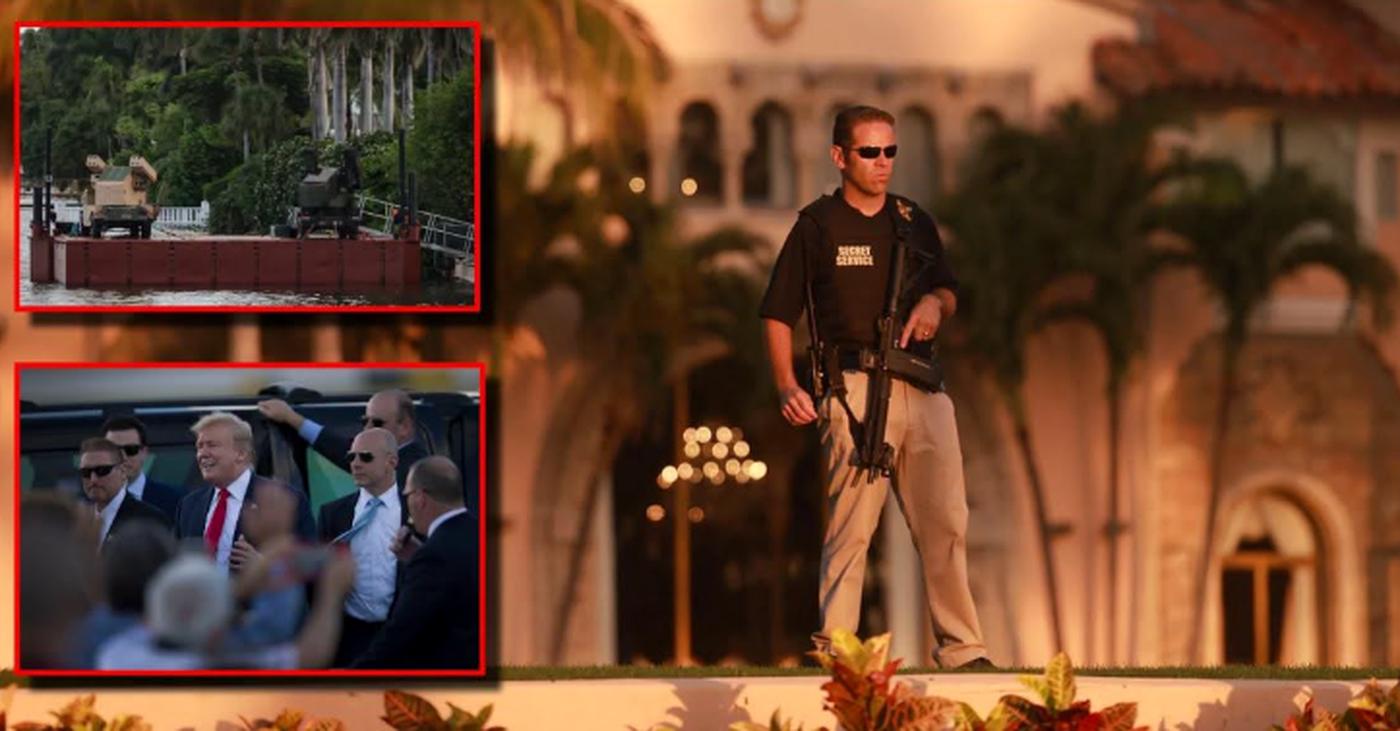
Federal officials have deployed ground-based air-defense systems around Trump’s Mar-a-Lago estate, significantly expanding protection against potential drones and other airborne threats.
The new equipment includes defensive assets positioned on a floating barge immediately west of Trump’s 17-acre Palm Beach property, the Palm Beach Post reported.
Additional systems have been positioned near President Donald J. Trump International Airport, where Air Force One parks during Trump’s visits to South Florida.
NORAD and U.S. Northern Command confirmed that ground-based air-defense assets were recently deployed in and around Mar-a-Lago at the Secret Service’s request.
Officials declined to disclose specific operational details about the systems because of security considerations and have not announced any particular threat prompting their deployment.
The Secret Service said the additional equipment reflects the heightened security environment surrounding the president and other individuals receiving federal protection.
“The U.S. Secret Service continues to operate in a heightened threat environment,” an agency spokesperson said while confirming additional counter-drone capabilities.
Photographs taken near Mar-a-Lago show what experts identified as Avenger Air Defense Systems mounted on military Humvees.
Each Avenger features a rotating turret carrying two missile pods capable of launching short-range, infrared-guided Stinger missiles, according to U.S. Army specifications.
The mobile systems are designed to defend against low-altitude airborne threats including drones, helicopters, cruise missiles and fixed-wing aircraft.
A Palm Beach Daily News photographer first observed the newly deployed equipment Oct. 23, shortly before Trump arrived at Mar-a-Lago for an overnight stay.
Former Navy fighter pilot Matthew Buckley told CBS12 that such systems provide another defensive layer beyond existing flight restrictions and fighter aircraft capable of intercepting suspicious planes.
Buckley said drones represent a particularly challenging security concern because smaller unmanned aircraft can potentially approach protected locations differently than conventional airplanes.
The deployment comes as federal authorities consider making stringent airspace restrictions surrounding Mar-a-Lago permanent rather than relying primarily on temporary measures.
The Federal Aviation Administration proposed Special Air Traffic Rules in September that would establish permanent restrictions within approximately one nautical mile of Mar-a-Lago.
Under the proposal, the restricted area would extend from the surface to 2,000 feet, with aircraft required to satisfy specific conditions before entering.
The FAA said the Secret Service originally requested permanent restrictions because of “adverse threat intelligence” and persistent risks from unauthorized aircraft and unmanned aerial systems.
Temporary around-the-clock restrictions have already been imposed over the immediate Mar-a-Lago area, with additional presidential flight restrictions layered over them when Trump visits Palm Beach.
Federal officials have documented repeated violations of those restrictions since they were introduced.
More than 160 airplanes and drones breached the restricted Palm Beach airspace after the measures took effect in October 2025, according to an FAA court filing.
The FAA disclosed those figures during litigation brought by Palm Beach, West Palm Beach and Palm Beach County challenging aspects of the federal flight restrictions.
Local governments have raised concerns that the restrictions redirect aircraft over surrounding residential areas and create additional noise and aviation disruptions.
The Secret Service has maintained that the measures are necessary because Mar-a-Lago serves as Trump’s primary residence and a location where presidential business is frequently conducted.
The FAA’s proposed permanent rules would not completely prohibit aircraft from entering the designated area, unlike a traditional prohibited-airspace designation.
Instead, qualifying aircraft could transit the zone under tightly controlled conditions, including communications with air-traffic controllers and compliance with designated flight procedures.
Military, law-enforcement, firefighting, air-ambulance and other approved safety operations would also retain access under specified circumstances.
The proposal’s public-comment period closed Oct. 2, but the FAA has not yet finalized the permanent rules.
The visible missile systems represent a separate security measure and provide authorities with capabilities specifically intended to respond to airborne threats approaching protected areas.
Federal authorities have emphasized that their deployment should not be interpreted as confirmation that intelligence agencies have identified a specific imminent attack against Trump or Mar-a-Lago.
The Secret Service instead describes the deployment as part of its continuing effort to adapt presidential protection to emerging threats, particularly the rapidly expanding capabilities of unmanned aircraft.