‘Midnight Shocker’: SAVE America Act Gets 50 Votes in the Senate
For months, supporters of the SAVE America Act have heard the same argument from Senate leadership: the votes simply weren’t there.
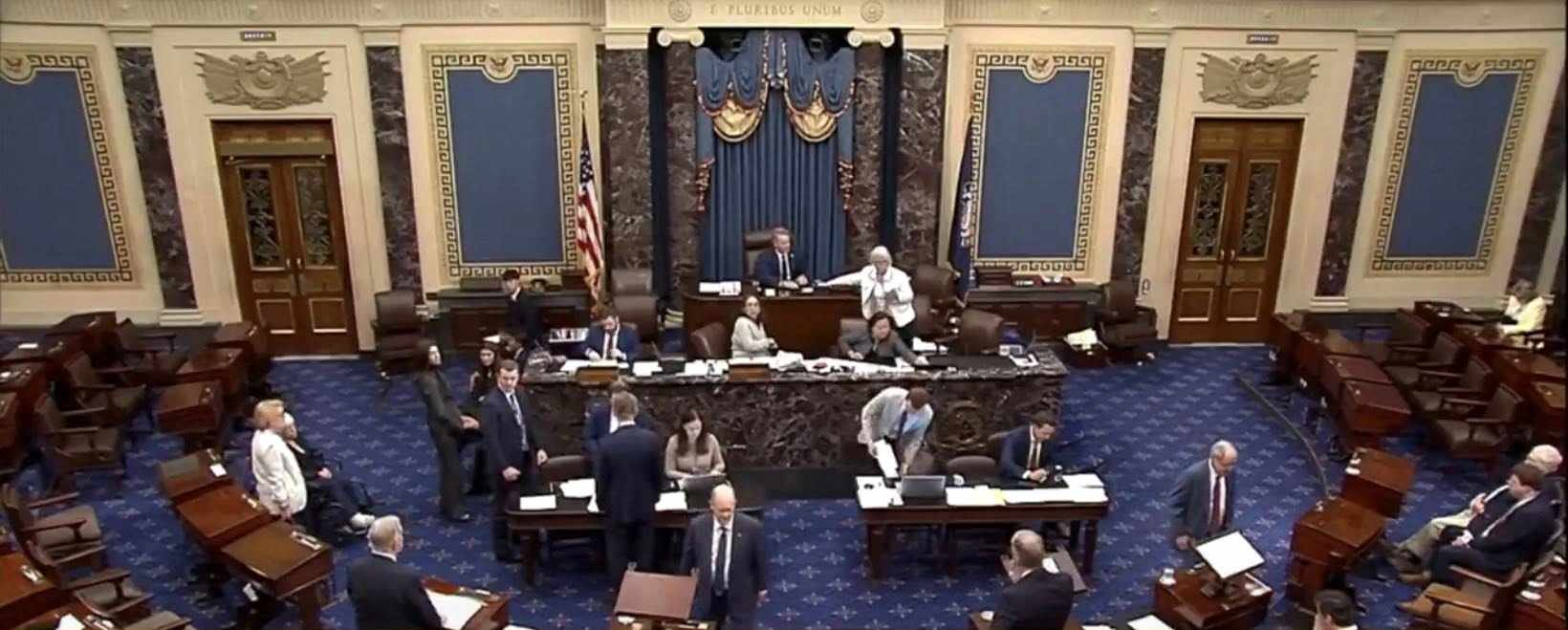
In a dramatic late-night vote during the Senate’s marathon “vote-a-rama” session, Republicans
demonstrated that the SAVE America Act can command majority support in the U. S. Senate.
The legislation, which would require proof of U. S. citizenship to register for federal elections
and strengthen voter verification requirements, received 50 votes in favor and 49 against.
But despite winning a majority, the measure still failed.
The reason wasn’t a lack of support
It was the Senate’s 60-vote threshold for overcoming procedural barriers, commonly known as the filibuster.
For supporters of election integrity legislation, that distinction is significant.
The vote showed that a majority of senators support the House-passed SAVE America Act.
What prevented its adoption was not the underlying proposal itself, but Senate rules that require a supermajority for certain actions.
The late night showdown began when Sen
Mike Lee (R-UT) forced a vote on the House-passed version of the SAVE America Act during consideration of a broader reconciliation package.
The proposal would require individuals registering to vote in federal elections to provide
documentary proof of citizenship while also strengthening voter identification standards.
Lee argued on the Senate floor that such protections are necessary to ensure public confidence in elections.
The Department of Homeland Security has found tens of thousands of registered non citizens in the United States,” Lee said while urging senators to support the amendment
The vote came after an earlier election-integrity proposal offered by Sen. Lindsey Graham (R-SC) failed by a 48-50 margin.
That amendment attracted opposition from four Republican senators: Susan Collins of Maine,
Lisa Murkowski of Alaska, Mitch McConnell of Kentucky, and Thom Tillis of North Carolina.
However, when Lee offered the clean House version of the SAVE Act later in the evening, Collins switched her vote and joined most of the Republican conference in support
The final tally was 50-49.
That result is politically significant because it demonstrated that supporters can assemble a Senate majority behind the legislation.
Vice President JD Vance was available to cast a tie breaking vote if necessary, meaning Republicans effectively proved they can reach 51 votes in support of the measure
The problem, supporters argue, is that 51 votes aren’t enough under current Senate rules.
Because the SAVE Act amendment was offered as part of a reconciliation package, waiving certain budget rules required a three-fifths supermajority, or 60 votes.
Every Democrat voted against the amendment, preventing it from reaching that threshold
The outcome immediately reignited debate over the Senate filibuster.
Senate Majority Leader John Thune has repeatedly pointed to the 60-vote requirement
as the primary obstacle standing in the way of election-related legislation.
Supporters of the SAVE Act now point to the result as evidence that the legislation has majority support and that Senate procedure is the only thing preventing it from becoming law
For years, supporters of major legislation have run into the same obstacle: the modern Senate filibuster.
Critics often refer to it as a “zombie filibuster” because senators no longer have to physically hold the floor and defend their opposition.
Instead, a simple threat to filibuster is enough to trigger the 60-vote requirement that effectively blocks legislation from advancing.
https://youtu.be/BnJR0YHNkiAThat wasn’t how many Americans imagine the filibuster working
Historically, senators who wanted to stop a bill had to remain on the Senate floor, speak continuously,
and publicly defend their position for as long as they could. Once they stopped speaking or failed to maintain enough support,
the Senate could move forward with a simple majority vote.
As a result, some Republicans and election-integrity advocates are increasingly calling for a return to a “talking filibuster. ”
Under that approach, senators opposing legislation such as the SAVE America Act would be required to physically hold the floor and sustain debate
If they could no longer do so, the Senate could eventually proceed to a final vote.
Supporters argue that such a reform would preserve minority rights while preventing a small
group of senators from indefinitely blocking legislation behind procedural barriers.
The Senate’s floor vote added fuel to that argument.
https://youtu.be/BnJR0YHNkiA