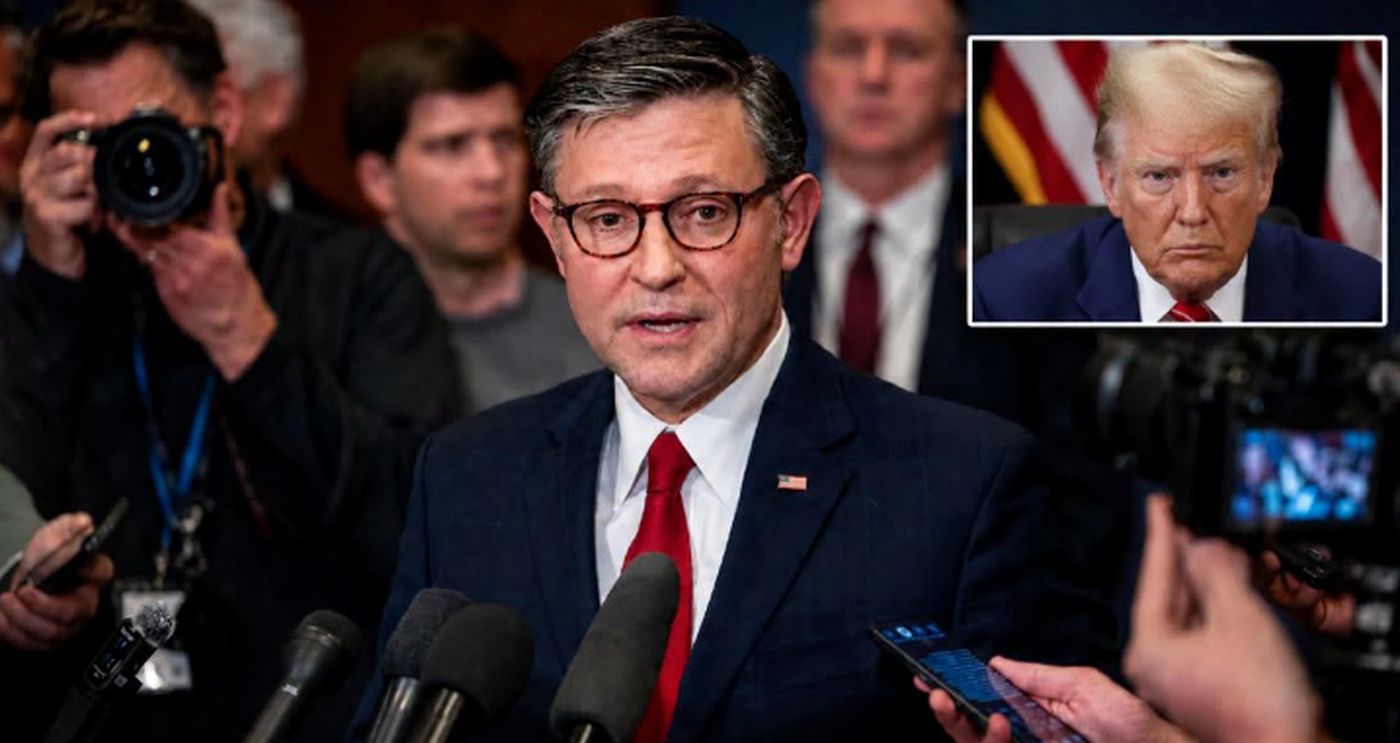
House Speaker Mike Johnson gave a very positive update on Republicans as early voting continues and Election Day for the midterms is a week away.
Johnson told Fox News host Laura Ingraham he’s very confident in GOP chances to keep control of Congress and continue delivering on President Donald Trump’s agenda for America.
To kick off the segment, Ingraham played a clip of House Minority Leader Hakeem Jeffries (D-N.Y.), who she said was already acting like he’ll be Speaker next January.
She also noted that Jeffries oddly hinted that if Republicans lose, there may not be a “peaceful transition” of power, which she and Johnson both mocked and dismissed.
“Of course it will be peaceful. I have no idea what Hakeem Jeffries is talking about,” Johnson responded after Ingraham played the clip.
“That’s a normal circumstance on Capitol Hill,” he continued, before discussing Republican chances to remain in control.
“Look, we are very excited, Laura, we’re on the eve, we’re just a week out from this election now. The polls are grossly underestimating public enthusiasm across the country,” he said.
“I’m traveling the country nonstop. I will be in 21 more states over the next just next week between now and the election. Thirty-nine districts last week, scores of states,” Johnson continued.
“We have been from coast to coast. I’m telling you the polling isn’t accurate,” he said.
“The American people understand this is a contrast election. We do not want to go back to crazy,” the Louisiana Republican added.
“I’m afraid if these Democrats took control of Congress, it would be crazier even than the Obama years and the Biden-Harris years because they have taken a far lurch to the left. And people see that I think it’s going to juice enthusiasm for our side,” he noted further.
The discussion then turned to polling, which has been controversial, to say the least, over the past several election cycles.
Ingraham noted that generic polling seemed to favor Democrats, at least on retaking control of the House, but Johnson pushed back, saying two major polling firms a week ago admitted their numbers (favoring Democrats) were fabricated.
WATCH:
Meanwhile, Republican voters have largely decided who they want to support for president in 2028, while a large plurality of Democrats remain undecided.
Vice President JD Vance has emerged as the early leader, while nearly half of Democratic primary voters remain undecided about who should represent their party after President Donald Trump leaves office, according to a new New York Times/Siena University poll.
The survey found 33% of Republican primary voters choosing Vance as their preferred nominee, giving the vice president a 10-point advantage over Secretary of State Marco Rubio, who finished second with 23%.
The contrast on the Democratic side was striking, with 45% of Democratic primary voters saying they did not know whom they would support if their party’s presidential primary were held today.
Former Vice President Kamala Harris received 12%, making her the most frequently named Democratic candidate, while California Gov. Gavin Newsom followed with 9%.
Former Transportation Secretary Pete Buttigieg received 7%, Rep. Alexandria Ocasio-Cortez of New York drew 6%, Georgia Sen. Jon Ossoff received 4% and Arizona Sen. Mark Kelly registered 3%.
Another 15% of Democratic respondents volunteered someone outside the listed field, further underscoring how unsettled the party’s potential 2028 contest remains more than two years before the first presidential primaries.
The Republican results showed considerably more consolidation around two figures closely associated with the Trump administration, as Vance and Rubio combined for support from 56% of GOP primary voters.
Trump himself received 8% when included as an option, despite the Constitution’s 22nd Amendment barring anyone from being elected president more than twice, while Florida Gov. Ron DeSantis received 3%.
Twenty-six percent of Republican respondents said they were undecided, a substantial number but still far below the 45% recorded among Democratic primary voters.
The poll provides an early snapshot rather than a prediction of the 2028 race, particularly because no major-party primary campaign is formally underway and the eventual fields could look substantially different by the time candidates begin announcing their campaigns.