The Colorado Supreme Court on Monday rejected three proposed ballot measures that sought to change the state’s congressional redistricting process ahead of the 2028 elections.
Had the initiatives qualified for the November ballot and been approved by voters, the revised congressional map would have taken effect for the 2028 elections
The proposals, backed by a group called Coloradans for a Level Playing Field, were aimed at temporarily suspending Colorado’s independent redistricting commission—created by voters in 2018—and allowing voters to approve a new congressional map for the 2028 and 2030 election cycles.
Two companion measures would have separately paused the commission and implemented new district boundaries.
Supporters argued the changes were necessary to redraw district lines, while opponents contended they would have significantly altered the state’s current redistricting process.
In three separate opinions, the Colorado Supreme Court ruled that each proposed measure violated the state’s constitutional “single subject” requirement, preventing them from moving forward, NBC News reported.
“Instead, it represents a seismic shift to Colorado’s longstanding redistricting process enshrined in the state constitution,” her opinion noted further.
In a second unanimous opinion, the Colorado Supreme Court concluded that dividing the original proposal into two separate ballot measures still failed to satisfy the state’s single-subject requirement.
The legal challenge comes amid a broader national debate over mid-decade congressional redistricting.
The issue gained momentum last year after President Donald Trump encouraged Republican-led states to consider redrawing congressional maps in an effort to strengthen the GOP’s narrow majority in the U.S. House of Representatives.
Virginia Democrats advanced a comparable ballot measure this year that sought to bypass the state’s independent redistricting commission and adopt a new congressional map. Although voters narrowly approved the proposal, the Virginia Supreme Court later blocked it from taking effect, NBC News noted.
“Changing the constitutionally mandated frequency of redistricting — however temporary the change — is not merely a mechanism to administer the new congressional district map,” Chief Justice Monica Marquez wrote in one unanimous decision
🚨 WOW! In a HUGE loss to the left, the Colorado Supreme Court has STRUCK DOWN a Democrat plan to redraw the state’s Congressional map by adding +3 blue seats
— Eric Daugherty (@EricLDaugh) June 29, 2026
The delegation will REMAIN 4R-4D 👏🏻
Good! Another redistricting win 🔥
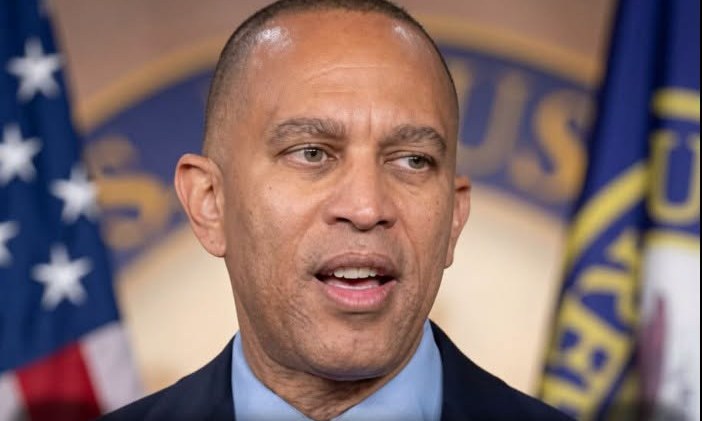
Hakeem Jeffries is livid. pic.twitter.com/GPZCTul0jx
>June 29, 2026 __PRESVEND__
In its May 4-3 ruling, the Virginia Supreme Court invalidated the voter-approved congressional map, finding that Democratic lawmakers violated procedural requirements under the state constitution when placing the referendum on the ballot.
The ruling forced Virginia to redraw its congressional districts ahead of the 2026 midterm elections and erased what Democrats hoped would become a 10-1 advantage in the state’s congressional delegation.
Before the ruling, Jeffries had strongly defended the effort and argued that Democrats had a strong legal basis.
“The law is with us in Virginia,” Jeffries previously said while promoting the redistricting plan.
The Virginia case comes amid a broader nationwide redistricting battle that has accelerated dramatically ahead of the 2026 elections.
Republicans appear poised to enter November’s midterm elections with a significant advantage created by redistricting efforts across the country, as a coast-to-coast battle over congressional maps nears its conclusion.
House of Representatives.
Since then, both parties have engaged in an increasingly aggressive struggle over congressional boundaries, but Republicans currently hold the upper hand.