The U.S. Supreme Court has issued a 6–3 decision in Zorn v. Linton, reinforcing the standard for qualified
immunity and reversing a lower court ruling that had denied immunity to a Vermont police officer.
The case arose from a sit-in protest inside the Vermont State House. Protester Shela Linton refused to leave
after the building closed for the night. Sgt. Jacob Zorn ordered her to stand and warned that force
would be used if she continued to resist. When Linton refused, Zorn placed her arm behind her back
in a rear wristlock, applied pressure, and lifted her to her feet.
Linton filed a civil rights lawsuit under 42 U.S.C. § 1983, alleging excessive force in violation of the
Fourth Amendment. A federal district court granted summary judgment to Zorn, holding that he was entitled to qualified
immunity because it was not “clearly established” that his specific actions were unconstitutional in those circumstances.
The U.S. Court of Appeals for the Second Circuit reversed, relying on a 2004 case, Amnesty America v.
West Hartford, which held that the “gratuitous” use of a rear wristlock on a protester passively resisting arrest
could constitute excessive force. The Supreme Court reversed the Second Circuit and reinstated qualified immunity for Zorn.
The Court reiterated that government officials are shielded from civil liability unless they violate “clearly established” law. To
meet that standard, courts generally must identify a prior case where an officer acting under similar circumstances was
held to have violated the Constitution.
The justices concluded that Amnesty America did not clearly establish that Zorn’s conduct — lifting a noncompliant protester
using a wristlock after warning that force would be applied — violated the Fourth Amendment. The Second Circuit,
the Court held, failed to identify precedent involving materially similar facts.
Justice Sonia Sotomayor dissented, joined by Justices Elena Kagan and Ketanji Brown Jackson. The dissent argued that a
jury should have been allowed to determine whether the force used was excessive and whether the right at
issue was clearly established.
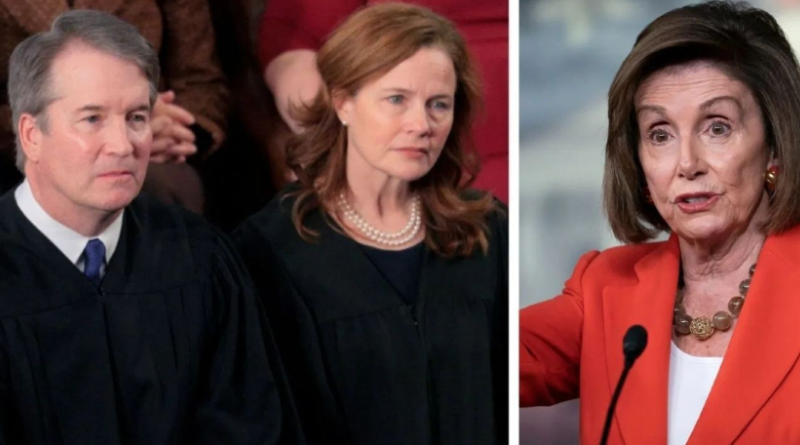
Former House Speaker Nancy Pelosi recently slammed ICE agents and came out against them being stationed to help
at San Francisco’s airports.
“It’s completely wrong, ICE agents are not trained for the job they have they’re inadequate for that and
they move on to another job, and inadequately trained to be at the airport,” Pelosi said.
The ruling reinforces a demanding standard for overcoming qualified immunity in civil rights cases and signals continued judicial
insistence on fact-specific precedent before officers can be held personally liable.
Beyond the immediate case, the decision arrives amid growing political tensions surrounding federal immigration enforcement.
Several Democratic lawmakers in California have introduced legislation aimed at expanding legal avenues to sue federal immigration officers
and restricting their operations. California’s state Senate recently advanced a measure that would make it easier to bring
civil rights claims against federal agents, following recent immigration enforcement incidents.
Other proposals include taxing private immigration detention centers, limiting cooperation between local police and federal immigration authorities, and
restricting courthouse arrests.
The Supreme Court’s decision in Zorn directly addresses civil liability under § 1983 for state officers, but its
reasoning mirrors standards the Court has applied in cases involving federal officers under related doctrines.
Legal observers note that the Court has repeatedly emphasized that qualified immunity protects officers unless prior case law
places the constitutional violation “beyond debate.”
The timing of the ruling may affect ongoing discussions about potential civil and criminal cases targeting Immigration and
Customs Enforcement (ICE) personnel and other federal law enforcement officers. Some state-level proposals have sought to restrict anonymity
protections, including mask use, in order to facilitate identification in lawsuits or prosecutions.
While the Court’s ruling does not directly address ICE operations, its reaffirmation of a strict qualified immunity standard
underscores that courts require closely analogous precedent before allowing suits to proceed against individual officers.
The decision was issued without a named author in a per curiam format, reflecting a majority consensus. The
6–3 split aligned along ideological lines, with the Court’s conservative majority in the majority and its liberal bloc
dissenting.
The ruling is likely to be cited in future litigation involving claims of excessive force, protest policing, and
federal immigration enforcement.
For now, the Supreme Court has clarified that broad principles about excessive force are insufficient to overcome qualified
immunity. Plaintiffs must point to prior cases involving closely comparable facts to proceed with personal-capacity claims against officers.
The Court’s opinion narrows the pathway for civil suits in use-of-force cases and reinforces protections for law enforcement
officers operating in dynamic protest and arrest scenarios.