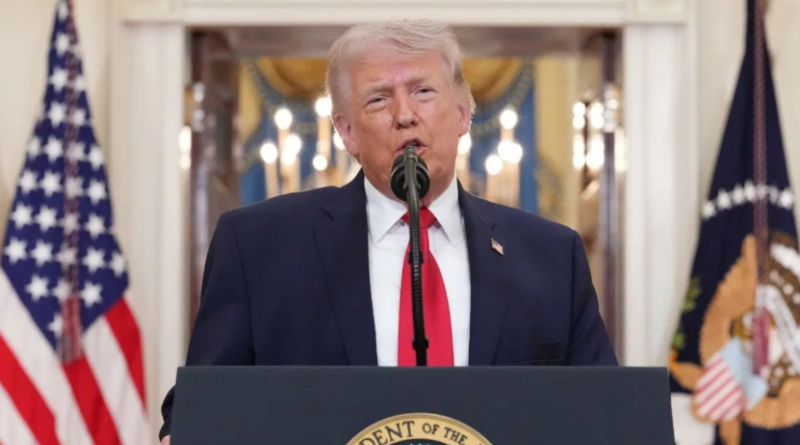
President Donald Trump has not approved a proposal drafted by nations that calls for a
President Donald Trump has not approved a proposal drafted by nations that calls for a 45-day ceasefire and the reopening of the Strait of Hormuz. Iran has stated that it has developed a response to the US’s demands to end the war and has rejected a temporary ceasefire.
The plan, which was sent to Iran and the United States late on Sunday, is seen as a desperate attempt to prevent Trump’s threats of massive strikes on Iranian infrastructure, including power plants, should the Strait of Hormuz remain blocked.
According to a White House official, Trump has not approved the plan.
The president is expected to address the war today at a news conference at 1 p.m. ET in the White House.
Pakistan, Egypt, and Turkey have mediated the two warring nations, but last week, indirect negotiations came to a standstill, and efforts to hold a face-to-face meeting seemed to come to an end.
The most recent proposal was forwarded to US special envoy Steve Witkoff and Iran’s Foreign Minister Abbas Araghchi. It is hoped that the 45-day ceasefire window will enable talks to put an end to the conflict for good.
Iran already seemed to oppose any short term ceasefire, claiming that it would give enemies
Iran already seemed to oppose any short-term ceasefire, claiming that it would give enemies time to stop and get ready to resume the conflict.
However, mediators are optimistic that the plan will be implemented prior to Trump’s Tuesday deadline of 8 p.m. ET. The ceasefire proposal was first covered by Axios.
The top tier of Israel’s multi-tiered defense system is the Arrow system, which is intended to intercept long-range ballistic missiles both outside and at the edge of the atmosphere. It has been Iran’s main weapon in both the ongoing conflict and the June 12-day war against Israel.
The ministerial committee for procurement approved the decision, which was put forth by Defense Minister Israel Katz and ministry director General Amir Baraam. According to a statement from the defense ministry, it will further a new agreement with Israel’s Aerospace Industries that “will enable a substantial increase in both the production rate and number of interceptors, as part of preparations for developments in the campaign.”
The action comes after rumors that Israel’s interceptor stockpiles may be under stress. Israeli military officials refuted the Semafor report in March, citing US officials who claimed that Israel had told the US that it was “running critically low” on interceptors.
Katz said Monday that “Israel has sufficient interceptors to defend its citizens,” adding that the move is intended to “ensure continued operational freedom and the necessary endurance.”
The ayatollah regime should know: the state of Israel is strong and resilient, prepared to
“The ayatollah regime should know: the state of Israel is strong and resilient, prepared to continue the campaign as long as necessary,” Katz said.
The United Arab Emirates insists that any ceasefire in Iran must address Gulf Arab states’ security concerns and avoid “a much more dangerous environment in the region,” a top official said.
Anwar Gargash, advisor to the UAE president, told CNN that Abu Dhabi wants “to see an end to this conflict, but an end to this conflict should not also create a continuous instability in the region.”
Any agreement would have to address Tehran’s nuclear program as well as the missiles and drones “which are still raining on us and on other countries.”
“And then, if Iran also wants to see a non-belligerence agreement, that agreement has to extend to everybody. It’s not only American-Israeli actions against Iran, but it has to be also Iran’s belligerence against its neighbors,” he said.
Iran’s attacks on its Gulf Arab neighbors are likely to “concretize” the US role in the Gulf, “not reduce it,” he said. “We will also see Israeli influence become more prominent in the Gulf, not less.”