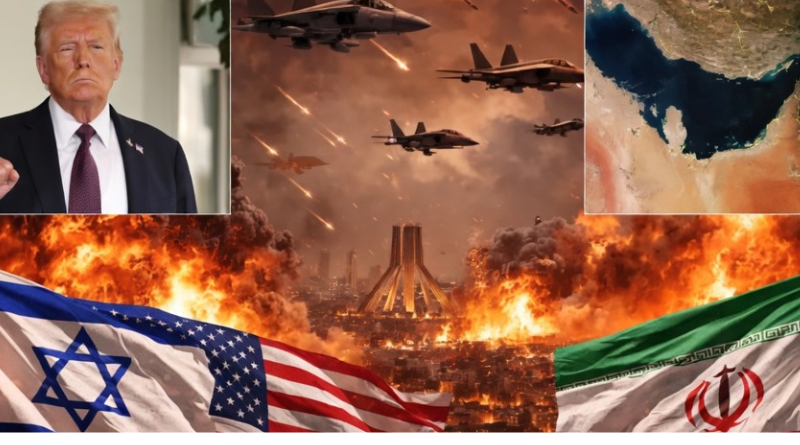
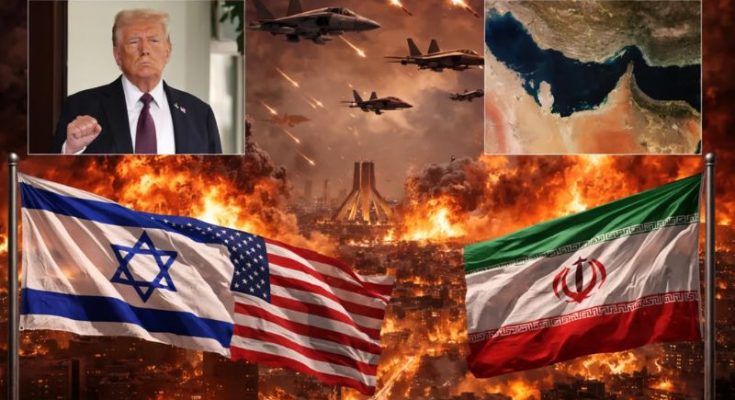
In a dramatic escalation, the United States and Israel carried out coordinated airstrikes on Iranian targets early Saturday, in what U.S. officials called “Operation Epic Fury.” The strikes hit IRGC command centers, ballistic missile sites, air defense systems, nuclear-related facilities, and key regime infrastructure across Tehran, Isfahan, Qom, Kermanshah, and Karaj. President Donald Trump described the operation as necessary to eliminate “imminent threats” from Iran’s nuclear ambitions and proxy networks, while Israeli Prime Minister Benjamin Netanyahu framed the strikes as preemptive moves against an “existential threat.” Initial reports suggested that Supreme Leader Ali Khamenei may have been killed, though Iranian state media denied this, saying he remained “safe and sound.” Analysts noted that the rhetoric represents a shift toward regime-change language, with Trump calling on Iranians to overthrow decades of theocratic rule.
Iran Responds with Missiles, Drones, and Maritime Warnings
Iran’s response was immediate and multifaceted. The IRGC launched ballistic missiles and drones targeting Israel and U.S. military bases throughout the region, including Al Udeid Air Base in Qatar, Al Dhafra in the UAE, the Fifth Fleet headquarters in Bahrain, Ali Al Salem in Kuwait, and sites in Jordan, Iraq, and Saudi Arabia. Explosions in multiple Gulf capitals heightened fears of a wider regional war.
The IRGC Navy escalated tensions further, issuing warnings via VHF Channel 16 to commercial vessels in the Strait of Hormuz, declaring the waterway closed and labeling passage “unsafe” or “banned for all ships.” EU and UK maritime authorities confirmed these broadcasts. While Tehran has not issued a formal nationwide blockade—likely to avoid self-inflicted economic damage—the warnings have already disrupted shipping. Tanker tracking data show vessels rerouting, slowing, or turning back, and some major oil and LNG shippers have suspended operations. The U.S. Navy cautioned that it could not guarantee the safety of commercial shipping in the Gulf.
The Strait of Hormuz: Global Energy Lifeline
The Strait of Hormuz, only 21 miles wide at its narrowest, connects the Persian Gulf to the Gulf of Oman and Arabian Sea, and handles roughly 20–21 million barrels of crude and refined products per day, about one-fifth of global oil consumption, along with significant LNG shipments from Qatar. Key exporters reliant on the strait include Saudi Arabia, Iraq, the UAE, Kuwait, and Qatar. A sustained disruption would force alternative routes around Africa or limited pipeline use, sharply increasing costs and delays.
While Iran has threatened to close the strait during past crises, a full blockade has never been enforced. Analysts warn that Iran’s asymmetric capabilities—fast attack boats, anti-ship missiles, naval mines, and shore-based launchers—could inflict significant damage without achieving full naval dominance. U.S. strikes reportedly targeted Iranian naval assets, potentially weakening Tehran’s enforcement ability. President Trump has vowed to “obliterate” Iran’s navy if necessary, with the Fifth Fleet on high alert to protect shipping.
Market and Economic Implications
Oil markets reacted immediately. Brent crude closed at $72 per barrel Friday, but analysts expect sharp spikes when trading resumes, potentially $5–20+ per barrel initially, with Barclays projecting $100 if disruptions persist. Prolonged closure could push prices to $120–150+, while partial flow reductions would still add significant war-risk premiums.
Global consequences could be severe. U.S. gasoline prices might rise to $4.50–6+ per gallon, inflation would accelerate, and consumer spending could suffer. Asian importers, including China, India, Japan, and South Korea, are particularly vulnerable. Shipping insurance rates have tripled in some cases, and LNG prices could surge, worsening energy shortages in Europe and Asia. Economists warn that extended disruptions could slow global growth, weigh on stock markets, and trigger safe-haven demand for gold and Treasurys.
Escalation Risks and Geopolitical Stakes
This marks the second major U.S. strike on an oil-producing nation in 2026, following Venezuela. Iran’s strategic position, proxy networks—including Houthis and Hezbollah—and access to the Strait of Hormuz amplify risks. Gulf states hosting U.S. forces are directly exposed, while diplomatic channels appear frozen.
Tehran may feel it is on “death ground,” prompting potential retaliation via cyberattacks, terrorism, or strikes on regional oil infrastructure. Yet economic dependence on oil exports may limit extreme measures. As of late February 28, 2026, shipping continues through the strait, though at reduced levels, with no confirmed attacks on vessels. The world watches anxiously: will the situation remain limited to harassment, or spiral into open naval conflict?