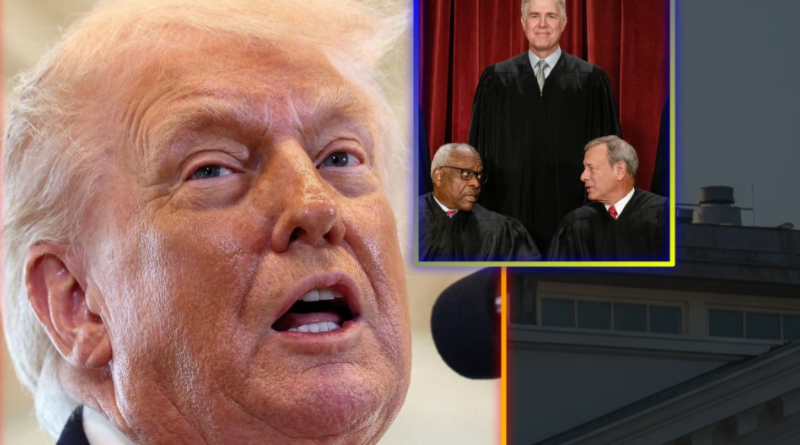
WASHINGTON, D.C. — In a pair of explosive legal decisions that are sending shockwaves through the American immigration enforcement system, both the Supreme Court and a Trump-appointed federal judge have just handed down major rulings regarding the treatment of detained migrants
In a pair of explosive legal decisions that are sending shockwaves through the American immigration
WASHINGTON, D.C. — In a pair of explosive legal decisions that are sending shockwaves through the American immigration enforcement system, both the Supreme Court and a Trump-appointed federal judge have just handed down major rulings regarding the treatment of detained migrants.
In a stunning display of judicial unity, the U.S. Supreme Court issued a unanimous 9-0 ruling against The GEO Group, a massive private prison company that contracts with Immigration and Customs Enforcement (ICE). The decision completely strips the company of its ability to claim “sovereign immunity” to avoid facing a class-action lawsuit over alleged forced labor.
THE $1-A-DAY LAWSUIT
The Supreme Court case, which has been winding its way through the legal system since 2014, centers on the Aurora Immigration Processing Center in Colorado.
Alejandro Menocal initiated a class-action lawsuit on behalf of detainees, alleging that GEO Group violated federal forced labor laws and Colorado’s unjust enrichment laws by forcing detainees to perform janitorial work for just $1 per day. GEO Group fiercely defended its practices and attempted to dismiss the lawsuit entirely, arguing that because it was acting as an ICE contractor, it was entitled to “derivative sovereign immunity”—meaning it could not be sued, just like the federal government.
Justice Elena Kagan, writing for the unanimous majority, forcefully dismantled that argument.
Nothing in the ICE contract’s terms instructed GEO to adopt the work rules at issue,”
“Nothing in the ICE contract’s terms instructed GEO to adopt the work rules at issue,” Kagan wrote, noting that government contractors who violate the law or exceed their authority do not get to magically inherit the government’s immunity. “If eventually found liable, GEO may of course appeal… But GEO must wait until then.”
While Justices Clarence Thomas and Samuel Alito filed separate concurring opinions regarding the exact procedural reasoning, all nine justices agreed: GEO Group must face the trial.
Legal experts predict this 9-0 ruling will open the floodgates for similar lawsuits against private detention providers. GEO Group manages 98 facilities nationwide—including a highly controversial center in Newark, New Jersey, where Mayor Ras Baraka was arrested during a protest in May 2025.
TRUMP-APPOINTED JUDGE HOLDS DHS IN CONTEMPT
Meanwhile, in a separate but equally dramatic showdown, a federal judge appointed by President Donald Trump has officially found the Department of Homeland Security (DHS) in civil contempt.
Minnesota District Court Judge Eric C
Minnesota District Court Judge Eric C. Tostrud issued a blistering order last week after federal officials blatantly violated his explicit court order regarding the transportation of an immigrant detainee.
The detainee, identified in court documents as “Fernando T.,” filed a habeas corpus petition on January 19 seeking his release or a bond hearing, followed immediately by a request for a temporary restraining order to prevent his transfer. Judge Tostrud granted the order, explicitly prohibiting the federal government from moving Fernando.
In direct defiance of the judge’s order, the federal government transferred Fernando to a facility in El Paso, Texas, on January 22. To make matters worse, Fernando was eventually released in late January without any of his personal belongings.
Judge Tostrud was furious, noting that federal officials have failed to explain why they withheld the man’s belongings. In his civil contempt ruling, Tostrud ordered the federal government to compensate Fernando directly by paying for his return flight to Minnesota.
Between a unanimous Supreme Court ruling stripping contractors of immunity and a federal judge holding DHS in contempt, the legal landscape surrounding immigration enforcement is facing an unprecedented level of judicial scrutiny.v