Texas Republicans received an encouraging early voting projection Sunday, showing a substantial modeled advantage in the closely watched Senate race.
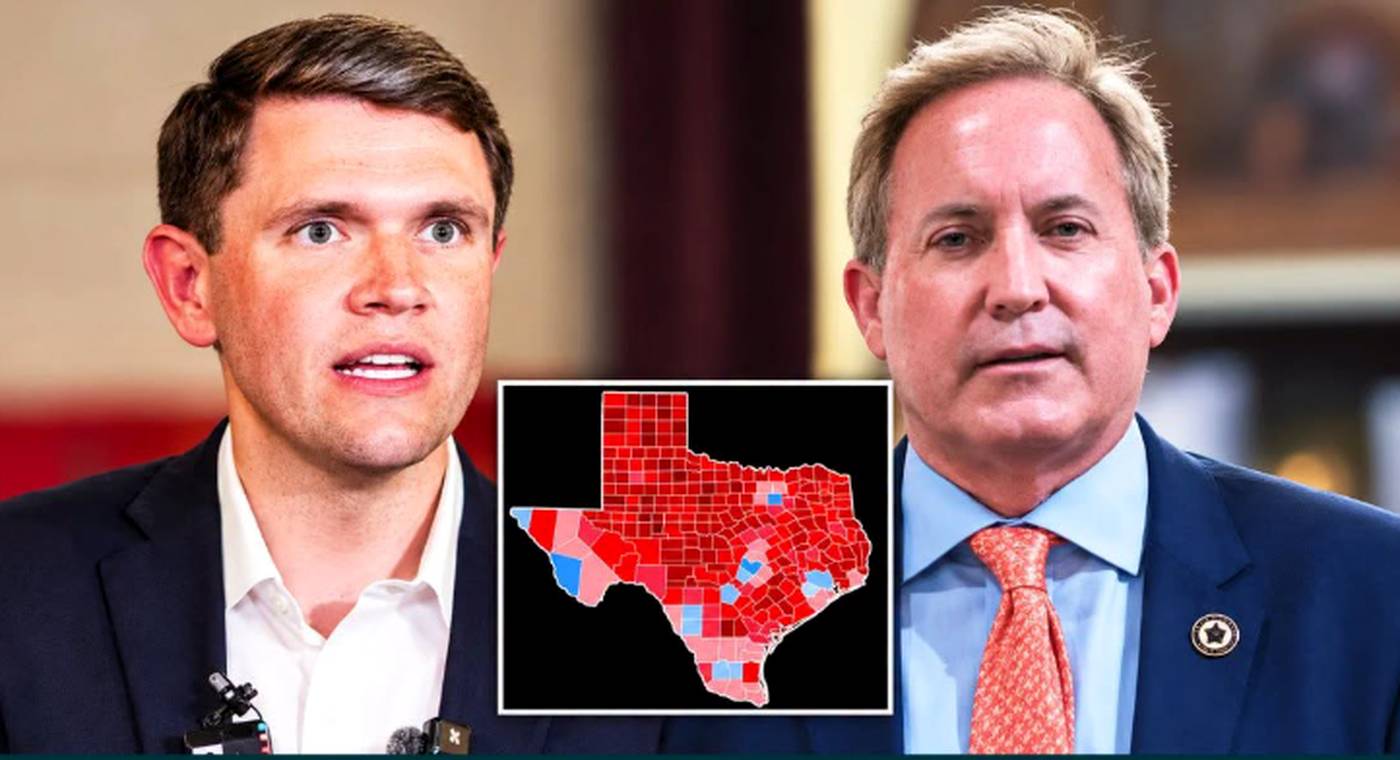
Election analyst E DataGuy published an October 25 graphic reporting 4,102,678 early and mail ballots statewide.
His model classified 2,258,996 ballots as Republican and 1,784,526 as Democratic, with 59,157 categorized separately.
The estimated Republican firewall reached 474,470 ballots, reflecting the difference between the two modeled partisan categories.
That is an increase of 219,326 from the analyst’s October 22 estimate of 255,144.
The new graphic projected Republican support between 51% and 57%, compared with 40% to 46% for Democrats.
Those figures are projections, not certified votes for Senate candidates or proof of a Republican lead.
Texas does not register voters by party, so identifying returned ballots as Republican or Democratic requires assumptions.
Its three displayed categories total 4,102,679, exceeding the reported statewide total by one ballot.
Republican Attorney General Ken Paxton faces Democratic state Representative James Talarico for the seat held by John Cornyn.
Texas has not elected a Democrat to statewide office since 1994, giving Republicans an important historical advantage.
President Donald Trump carried Texas by nearly 14 percentage points during the 2024 presidential election.
Early voting began October 19, with record participation reported in several large counties.
Campaign strategists caution that increased participation does not automatically benefit either political party.
A Fox News survey released October 21 showed Paxton slightly leading Talarico among likely voters.
For Republicans, the modeled firewall offers an encouraging organizing benchmark rather than a guarantee of victory.
Trump is scheduled to appear in Lubbock and Waco during the closing campaign period, according to reporting.
National Republican organizations also possess extensive financial resources for advertising, voter outreach, and campaign operations.
Trump’s flagship super PAC, MAGA Inc., began September with nearly $416 million available, according to federal disclosures.
The organization reported spending nearly $277 million from early September through mid-October supporting Republican candidates.
That figure includes transfers to allied committees, not simply advertising purchased directly by MAGA Inc.
MAGA Inc. transferred $200 million to No Going Back PAC and $25 million to Safety and Affordability PAC.
Federal filings showed MAGA Inc. still holding more than $164 million on October 14.
Its September and October balances describe different dates and must not be combined as simultaneous cash reserves.
Trump announced plans for his broader political operation to spend more than $400 million before Election Day.
His stated commitment encompasses advertising, rallies, voter contact, and other election activities across multiple states.
Reuters reported Trump-aligned committees spent more than $36 million supporting Paxton in Texas.
Those groups also devoted approximately $30.1 million to Mike Rogers in Michigan and over $28 million to Jon Husted.
Prominent MAGA Inc. contributors include Stephen Wynn, Stephen Schwarzman, and Diane Hendricks.
Reuters reported Wynn gave $8 million in September, while Schwarzman and Hendricks contributed $5 million each.
The National Republican Congressional Committee reported raising $50 million during the third quarter of 2026.
Its September receipts totaled $28.5 million, including a $14 million Republican National Committee transfer.
The committee entered October with approximately $61 million available and reported $250 million raised during this cycle.
The Democratic Congressional Campaign Committee had raised approximately $249 million and held $55.7 million entering October.
Those House committee balances are separate from resources directly supporting Paxton’s Senate campaign.
A Reuters review found three major Republican party committees collectively held approximately $187 million at September’s end.
Their Democratic counterparts held roughly $100 million, providing Republicans a substantial combined cash advantage.
Republican committees spent approximately $137 million on coordinated congressional activities between July and September.
Democratic committees spent approximately $55 million on comparable efforts during that reporting period.
For Texas Republicans, the latest model suggests organizational strength, while independent polling shows a genuinely competitive Senate contest.
November 3rd is Election Day.