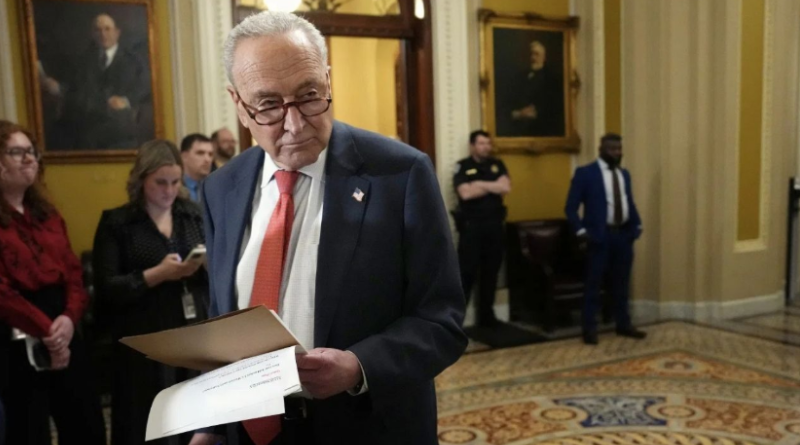
Senate Minority Leader Chuck Schumer engaged in more left-wing inflammatory rhetoric against Immigration and Customs Enforcement agents earlier
this week when he wrongly predicted that President Trump’s decision to send them into airports to assist the
TSA would lead to “trouble.”
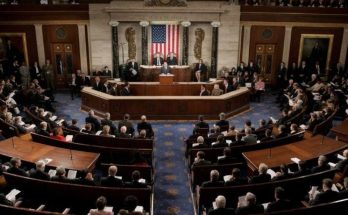
“Everywhere ICE goes, trouble follows,” Schumer said on the Senate floor. “We’ve seen that. And it is highly
likely the airports will be no exception.” Only, ICE agents deployed to 13 airports on Monday and Tuesday
without incident, freeing Transportation Security Administration agents to focus more on their regular duties to assist passengers and
reduce wait times.
“So, Donald Trump, the more you keep ICE agents at our airports, the more you will be reminding
people of how much chaos and fear ICE has already caused. It’s a terrible idea that could backfire
on the country and on Donald Trump,” Schumer added.
Schumer and other Democrats also falsely claimed that ICE agents would be taking over airport security lines from
TSA staff, when in reality ICE deployed to relieve TSA agents of mundane duties like guarding exits, freeing
more of them up to focus on their primary functions.
Not long after Schumer made his inflammatory remarks, local news agencies were reporting that lines at TSA checkpoints
in many of the airports where ICE agents were deployed had disappeared.
“I do want to point out, this is an empty line right now,” Bryanna Gallagher of WPVI-TV said
Tuesday morning during a live report from the Philadelphia airport. She added: “We are standing in the middle
where travelers come to check in for TSA. Yesterday, this was all the way back to the garage.
So good news today. Lines aren’t too bad.”
Her report did not credit ICE agents for helping to alleviate the bottlenecks and some of the passengers
she spoke to for her report were not keen on having them in airports. But what wasn’t in
question was the fact that lines were gone and that coincided directly with Trump’s deployment of ICE agents.
WATCH:
Meanwhile, Senate Democrats continue to block funding for TSA, Coast Guard, and other Department of Homeland Security agencies
due to their ongoing opposition to ICE’s mass deportation operations. Hundreds of TSA agents have left the department
after going weeks now without paychecks. And Republicans refuse to terminate the filibuster in order to pass new
funding on a simple majority vote.
That said, one Republican senator has offered a solution for another piece of important legislation that is ‘stuck’
at the moment.
John Kennedy (R-LA) is urging his party to pursue a dramatic procedural shift to pass the SAVE America
Act — by using budget reconciliation to bypass a Democratic filibuster and approve the bill with a simple
majority.
Under current plans, Senate Majority Leader John Thune has scheduled the SAVE America Act for consideration as standard
legislation, meaning it would require 60 votes to invoke cloture and overcome a filibuster. With Republicans holding 53
seats, at least seven Democrats would need to join them.
Kennedy argued that approach is unnecessary. Speaking on the Senate floor, Kennedy said Republicans should attempt to pass
the measure through reconciliation — a parliamentary process created under the Congressional Budget Act of 1974 that allows
certain budget-related legislation to pass with just 50 votes plus the vice president.
That means, if structured properly, the bill could pass with unified Republican support and a tie-breaking vote from
Vice President JD Vance. It could even contain a provision funding the TSA.
“That’s how we passed the one big, beautiful bill,” Kennedy said, referencing prior GOP legislation enacted over Democratic
opposition. He also noted that Democrats used reconciliation in 2021 to pass the $1.9 trillion American Rescue Plan
on a party-line vote.
Kennedy acknowledged that reconciliation is not simple. “Anything you propose through reconciliation has to be paid for. We
can find the money,” he said. “And anything you pass through reconciliation has to conform with the contours
of the Budget Control Act.”